
You have one product, and two regulators are about to describe it in two different ways. Borderline products, the kind that sit on the line between a drug and a device, can walk through a different front door in each region. In the United States, your first clinical trial filing might be an Investigational New Drug (IND) application. In Europe, that same product might need a Notified Body and a Conformite Europeenne (CE) mark instead. Knowing which door you are walking through, in each region, before you design the trial, is the difference between one clean program and two years of rework.
This article explains, in plain terms, how to tell which regulatory front door your product uses in the US and in Europe, why the two regions can reach different answers for the very same product, and how to plan for both at once. We keep the jargon light and expand every acronym on first use.

What “borderline products” and “combination products” actually mean
Two terms get used loosely, so start here. A borderline product is one that sits at the boundary between two regulatory categories, most often between a medical device and a medicine, where it is not obvious which set of rules applies. A combination product is different: it genuinely contains more than one type of regulated part working together.
- Borderline products: the question is which category the product belongs to. A wound gel, a nasal spray, or a substance you swallow may act like a device in one reading and like a medicine in another.
- Combination products: the product plainly has two parts. A drug-coated stent, a prefilled auto-injector, or a drug-eluting implant each pairs a device with a drug or biologic.
Both cases raise the same practical worry: which regulator is in charge, and which application do you file to start a trial? In the US, the answer hinges on a single idea, the primary mode of action (PMOA). This is the one mode of action that provides the most important therapeutic action of the product. Whichever part delivers the PMOA sets the lead reviewer and the paperwork.
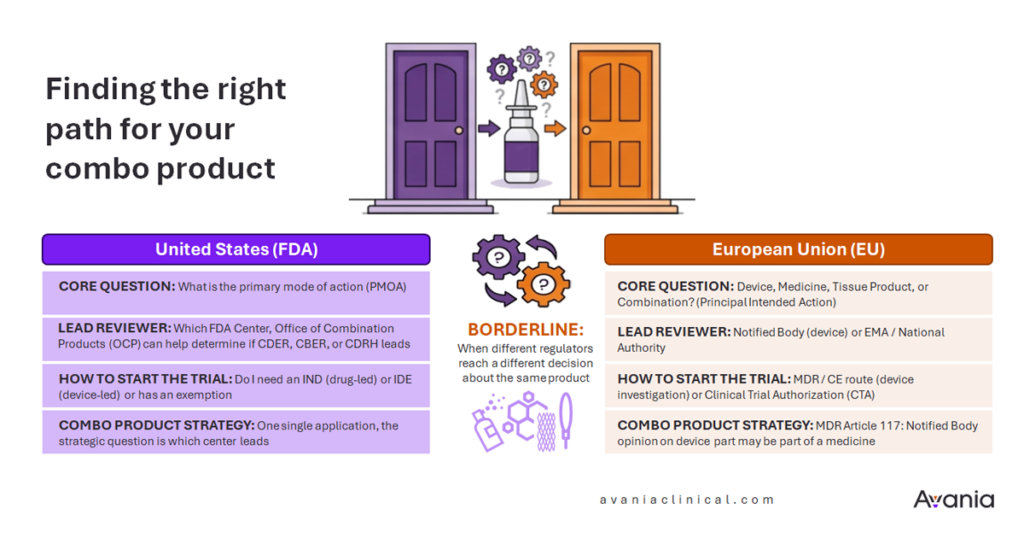
The US front door: an IND or an IDE, decided by primary mode of action
The US Food and Drug Administration (FDA) reviews products through different centers, and for borderline products the primary mode of action decides which center leads.
- Drug-led or biologic-led: you file an Investigational New Drug (IND) application before human testing, reviewed by the Center for Drug Evaluation and Research (CDER) or the Center for Biologics Evaluation and Research (CBER). The IND framework lives in 21 CFR Part 312.
- Device-led: you file an Investigational Device Exemption (IDE) instead, reviewed by the Center for Devices and Radiological Health (CDRH). The IDE framework lives in 21 CFR Part 812.
For a true combination product, FDA generally reviews it under a single application that matches the PMOA, with the other center consulting. So if a founder asks “do I need an IND or a CE mark,” the honest US answer is a prior question: is your product drug-led or device-led? That one determination routes you to an IND or an IDE. Get the PMOA call right early, because it drives your protocol, your endpoints, and your data expectations.
The EU front door: a Notified Body, the EMA, or MDR Article 117
Europe asks a slightly different question. Rather than starting with mode of action alone, the EU first sorts the product into a category, and the tests are set out in the EU Medical Device Regulation (MDR) 2017/745 and in guidance from the Medical Device Coordination Group (MDCG).
- If it is a device: it takes the device route. An independent conformity assessment organization called a Notified Body assesses it, and the product carries a CE mark. The clinical study runs as a device investigation under MDR.
- If it is a medicine: it takes the medicinal product route through the European Medicines Agency (EMA) or a national competent authority, and the trial runs under a clinical trial authorization.
The dividing line, per MDCG guidance, turns on the principal intended action. If the product achieves its main action by pharmacological, immunological, or metabolic means, it is a medicine. If it does not, it is a device. For products where a device and a medicine form a single integral unit, MDR Article 117 adds a step: the marketing authorization application for the medicine must include a Notified Body opinion confirming the device part meets the relevant general safety and performance requirements. In other words, even a medicine-led product in the EU can still need a Notified Body to weigh in on its device part.
Bottom line: The US asks which mode of action leads, and routes you to an IND or an IDE. The EU asks which category the product falls in, and for an integral device-drug still wants a Notified Body opinion on the device part.
Why the US and EU can disagree, and how to plan for both
Because the two regions apply different legal tests, they can label the same product differently. A product can be device-led in the US, so an IDE with CDRH, yet be handled as a medicine in the EU, so an EMA route with a Notified Body opinion on the device part. This is the heart of the “US IND vs EU Notified Body” problem: one product, two front doors, two evidence expectations, two timelines. If you build your program around only one region, the other can stall you late, after the protocol is locked and sites are enrolling.
The way to avoid that is to settle both classifications before the protocol is final:
- Map the primary mode of action early, and pressure-test it against both the US center logic and the EU category tests.
- Use the formal determination routes. In the US you can ask FDA for a classification through the Office of Combination Products. In the EU you can engage the competent authority and lean on the MDCG borderline guidance.
- Design one protocol that satisfies both, so the same trial generates the device evidence and the drug evidence each region will want, rather than two disconnected studies.
How Avania runs both front doors as one program
Avania builds the protocol and the site operations around both constituent parts and both regions from day one. We do not run the US track and the EU track as two disconnected projects that meet at the end. We run the device-led and drug-led pathways in parallel, so one region’s requirements do not stall the other. That means classifying the primary mode of action up front, preparing the US IND or IDE and the EU device or medicinal route on the same timeline, and building a single protocol that produces one coordinated evidence package both regulators can use. Avania supports, coordinates, and prepares these submissions; sponsors hold the approvals, and regulators clear the products. Our job is to make sure the two front doors open onto the same well-run trial.
The bottom line
Borderline products and combination products often face two front doors: an IND or IDE in the US, decided by primary mode of action, and a Notified Body, EMA, or MDR Article 117 route in the EU, decided by product category. The two regions can disagree, and the cost of finding out late is high. Settle both classifications before you lock the protocol, and run them as one program, not two.
Reference
1 U.S. Food and Drug Administration. (n.d.). 21 CFR Part 3, Product Jurisdiction (see 3.2(e), combination product; 3.2(m), primary mode of action). Electronic Code of Federal Regulations. https://www.ecfr.gov/current/title-21/chapter-I/subchapter-A/part-3
2 U.S. Food and Drug Administration. (n.d.). 21 CFR Part 312, Investigational New Drug Application. Electronic Code of Federal Regulations. https://www.ecfr.gov/current/title-21/chapter-I/subchapter-D/part-312
3 U.S. Food and Drug Administration. (n.d.). 21 CFR Part 812, Investigational Device Exemptions. Electronic Code of Federal Regulations. https://www.ecfr.gov/current/title-21/chapter-I/subchapter-H/part-812
4 U.S. Food and Drug Administration. (2022). Principles of premarket pathways for combination products: Guidance for industry and FDA staff. U.S. Department of Health and Human Services. https://www.fda.gov/regulatory-information/search-fda-guidance-documents/principles-premarket-pathways-combination-products
5 Medical Device Coordination Group. (2024). MDCG 2022-5 Rev.1: Guidance on borderline between medical devices and medicinal products under Regulation (EU) 2017/745 on medical devices. European Commission. https://health.ec.europa.eu/latest-updates/mdcg-2022-5-rev1-guidance-borderline-between-medical-devices-and-medicinal-products-under-regulation-2024-10-29_en
6 European Medicines Agency. (2021). Guideline on quality documentation for medicinal products when used with a medical device (EMA/CHMP/QWP/BWP/259165/2019). https://www.ema.europa.eu/en/quality-documentation-medicinal-products-when-used-medical-device-scientific-guideline