
You are running one clinical study, on one product, but two different rulebooks want to govern it. A prefilled drug autoinjector, a drug-coated stent, or an antibiotic-loaded bone cement is a combination product, and the moment you plan its trial you hit a practical fork: does device Good Clinical Practice (GCP) apply, or drug and biologic GCP? In plain terms, the question is ISO 14155 vs ICH GCP, and answering it late can mean redoing work that regulators will not accept.
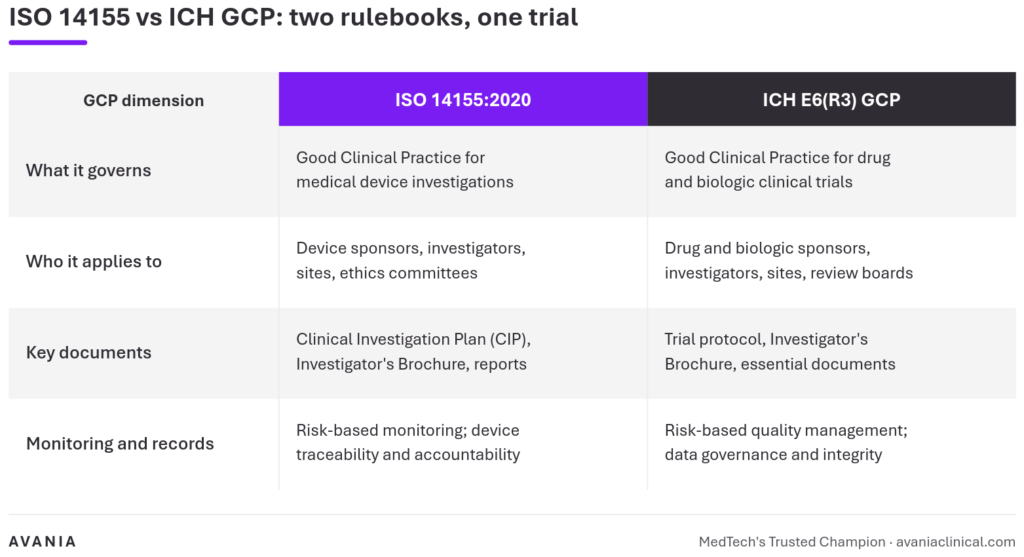
ISO 14155:2020 is the international standard for Good Clinical Practice in the clinical investigation of MedTech products. Think of it as the rulebook for how you design, run, record, and report a study of a device in human subjects. It exists to do two things at once: protect the people in the study and make sure the resulting data are credible enough for a regulator to rely on.
In practice, ISO 14155 sets out who is responsible for what and what you must document. A Clinical Investigation Plan (CIP)—the device world’s name for the study protocol—ties every endpoint back to the device’s intended purpose. Sponsors and principal investigators have clearly defined duties, supported by written quality procedures that cover the whole investigation. Risk-based monitoring ensures device accountability and traceability so every unit used in the study is tracked. In Europe, the standard is harmonized under the Medical Device Regulation (MDR) 2017/745, and in the United States it maps to the Investigational Device Exemption (IDE) framework at 21 CFR Part 812.
IICH E6 is the Good Clinical Practice guideline from the International Council for Harmonisation (ICH), the body that aligns drug and biologic trial rules across the United States, Europe, Japan, and beyond. ICH E6(R3) is its newest version, and it is the largest rewrite of drug GCP in roughly 30 years. Where the device world reads ISO 14155, the drug and biologic world reads ICH E6(R3). The timing matters because “device GCP vs drug GCP” is now a moving target.
- ICH E6(R3) reached Step 4, its final adopted stage, on January 6, 2025
- The U.S. Food and Drug Administration (FDA) published it as guidance for industry on September 9, 2025
- In the European Union, the overarching principles and Annex 1 took effect on July 23, 2025, with a second annex on newer trial designs phasing in during 2027
- The revision emphasizes risk-proportionate quality, quality by design, stronger data governance and data integrity, and modern formats such as decentralized and hybrid trials
Start with the product, not the paperwork. Under U.S. rules, a combination product is defined at 21 CFR Part 3 as a product that combines a drug, a device, and/or a biologic. The FDA assigns a lead center based on the product’s primary mode of action, meaning its single most important therapeutic effect. That lead center steers which GCP framework carries the most weight.
If the study is really evaluating the device constituent’s safety or performance, ISO 14155 is your center of gravity. If the study is evaluating the drug or biologic constituent, ICH E6(R3) governs. For borderline products (the ones that could reasonably be classified either way), an early regulatory determination is critical. Do not assume; ask. A borderline product settled late forces expensive protocol rework. The primary mode of action usually points to your lead standard, but a combination product rarely sits cleanly on one side of the ISO 14155 vs ICH GCP line.
Here is the part teams underestimate. In many combination product trials, both constituents are under scrutiny at once. Regulators expect the device constituent evidenced to device GCP and the drug or biologic constituent evidenced to drug GCP, inside the same study. Running two disconnected trials is slow and invites contradictions. Running one study that satisfies both standards is the goal, and that is a documentation problem as much as a clinical one.
This is where structured authoring earns its keep. Structured authoring means writing your content once as modular, reusable, standards-tagged components rather than as long, single-use documents. You author a monitoring section, a safety-reporting section, or a consent section one time, and you tag it with the requirement it satisfies, whether that is an ISO 14155 clause or an ICH E6(R3) expectation. Because each component knows which rule it answers, you can reuse it everywhere it is needed and see instantly where a gap remains.
Publishing is the step that follows. Publishing means assembling those authored components into the exact format a given regulator wants: a device clinical dossier in one place, an electronic Common Technical Document (eCTD) for the drug side in another, a European submission and a United States submission drawn from the same source. Author once, publish many times. One coherent evidence set, several submission-ready outputs, with no retyping and no drift between them.
Most contract research organizations (CROs) are built for either device trials or drug trials or adapted from pharma. Avania is built up from MedTech, not carved down from pharma. For combination products, we coordinate a single study that is authored and monitored to ISO 14155 and ICH E6(R3) together. Our regulatory and clinical development teams map each requirement to a structured, tagged component, so the device constituent and the drug or biologic constituent are each evidenced to the right GCP without duplicated effort. Practically, that means one integrated protocol and monitoring plan, structured authoring that keeps ISO and ICH requirements traceable side by side, and publishing that outputs the device dossier and the eCTD from the same content. The result is one coordinated evidence package, not two disconnected regulatory tracks, reducing the risk of late-stage remediation and accelerating your path to submission.
ISO 14155 is Good Clinical Practice for MedTech products; ICH E6(R3) is the modernized Good Clinical Practice for drugs and biologics. For a combination product, the primary mode of action points to your lead standard, but you often have to satisfy both. Author once, tag each component to its standard, and publish into every format you need, and a single trial can carry a combination product all the way to submission.
Ready to navigate combination product trials under both ISO 14155 and ICH E6(R3)?
Reference
1 International Organization for Standardization. (2020). ISO 14155:2020 Clinical investigation of medical devices for human subjects: Good clinical practice. ISO. https://www.iso.org/standard/71690.html
2 International Council for Harmonisation. (2025). ICH harmonised guideline: Good clinical practice (GCP) E6(R3), Step 4 version. ICH. https://database.ich.org/sites/default/files/ICH_E6(R3)_Step4_FinalGuideline_2025_0106.pdf
3 U.S. Food and Drug Administration. (2025). E6(R3) Good clinical practice (GCP): Guidance for industry. U.S. Department of Health and Human Services. https://www.fda.gov/regulatory-information/search-fda-guidance-documents/e6r3-good-clinical-practice-gcp
4 European Medicines Agency. (2025). ICH E6 Good clinical practice: Scientific guideline. EMA. https://www.ema.europa.eu/en/ich-e6-good-clinical-practice-scientific-guideline
5 U.S. Food and Drug Administration. (n.d.). Combination product definition: Combination product types. U.S. Department of Health and Human Services. https://www.fda.gov/combination-products/about-combination-products/combination-product-definition-combination-product-types