
The Food and Drug Administration (FDA) approved your diagnostic radiopharmaceutical. Now try to get a hospital to use it. For 17 years, Medicare paid the same amount for a scan whether the tracer inside it cost $40 or several thousand, because the tracer was bundled into the payment for the procedure. Expensive precision tracers were adopted slowly, unevenly, or not at all, regardless of clinical value. That is why radiopharmaceutical reimbursement, not clearance, is where most molecular imaging launches actually stall.
Here is the good news and the catch. In 2025 the payment gap finally started to close. In 2026 the real fight moved somewhere new. This is the short version of Avania’s white paper on diagnostic radiopharmaceutical coverage: what changed, the three problems that now decide access, and the one thing to do before August 31, 2026.
Approved but Not Paid, and What Changed in 2025
Under the Hospital Outpatient Prospective Payment System, Medicare pays hospitals in bundles. Starting in 2008, it folded diagnostic radiopharmaceuticals into the payment for the imaging procedure. For most supplies that is fine. For tracers it was distorting, because the category ranges from tens of dollars a dose to several thousand. Adopting an expensive new tracer meant a direct loss on every scan.
The Centers for Medicare and Medicaid Services (CMS) changed that in the Calendar Year 2025 rule. It began paying separately for diagnostic radiopharmaceuticals whose cost runs above a per-day threshold, set that first year at $630, roughly twice the $314 a day already buried in the bundled payment. Twenty-six products qualified in year one. The threshold rose to $655 for 2026, and the proposed 2027 rule puts it at $665. Separate payment is settled policy. The fight has moved.
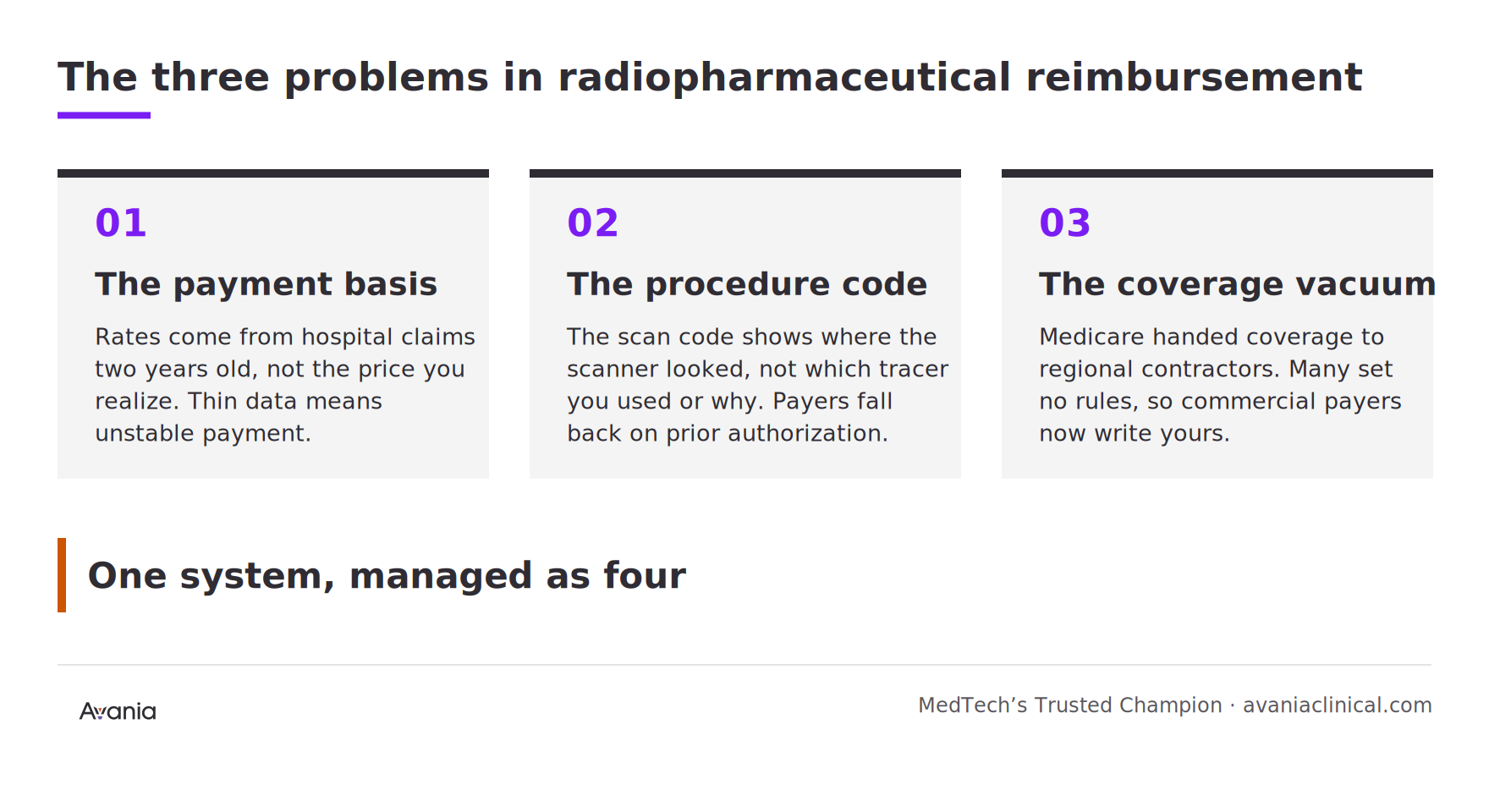
Three Problems that Decide Radiopharmaceutical Reimbursement
Separate payment exists. What it does not do is answer three questions, and those are where access is now won or lost.
1. The payment basis rewards volume you do not have
CMS calculates payment from mean unit cost, an average built from hospital claims filed about two years earlier. For a high-volume agent, thousands of claims smooth out the errors. For a novel tracer running a few thousand doses nationally, a handful of miscoded claims can move the national rate. Manufacturers have asked CMS to switch to average sales price (ASP), the net price they actually realize and can report directly. CMS kept mean unit cost in the 2025 and 2026 final rules but has signaled openness to change and says it will publish a voluntary ASP reporting framework for the category.
2. The procedure code cannot carry clinical intent
Positron emission tomography (PET) scans are billed under a small set of procedure codes that differ mainly by how much of the body the scanner covered. The code says where the scanner looked. It says nothing about which tracer was used, what molecular target it interrogated, or what clinical question the physician was answering. A precision receptor scan and a routine restaging scan carry the same code. Because payers cannot read intent from the code, they manage use through prior authorization instead. The access friction manufacturers feel is, at its root, a coding problem.
3. Coverage is written by whoever shows up
CMS has handed most molecular imaging coverage decisions to its regional Medicare Administrative Contractors (MACs). In several important categories, the contractors never wrote coverage criteria. Commercial payers filled the vacuum with their own policies, which spread because plans routinely draft policy by copying peers. For some tracers, the most detailed coverage criteria now sit in a private payer document, not a Medicare one. A manufacturer that lobbies only CMS is engaging the wrong body. We have written before about winning coverage one MAC at a time, and the same sequencing logic applies here.
Bottom line: These problems compound. Prior authorization suppresses use, thin use produces thin claims data, thin data makes the payment rate unstable, and unstable payment discourages the hospital investment that would grow use.
The Evidence Lesson Hiding in Amyloid PET
One recent history should shape every new tracer’s evidence plan. CMS long restricted amyloid PET under coverage with evidence development, and the Imaging Dementia, Evidence for Amyloid Scanning (IDEAS) study ran under that framework. IDEAS was a clear win on its face. Physician management changed in 60.2% of patients with mild cognitive impairment and 63.5% of those with dementia, far above the 30% target. But a follow-up analysis asked a harder question, whether the scans reduced hospitalizations and emergency visits, and it did not meet its target of a 10% relative reduction. In October 2023, CMS ended the evidence-development requirement and delegated amyloid PET coverage to the contractors.
The lesson is uncomfortable. Proving a scan is informative, and even that it changes what doctors do, was not enough. CMS asked whether the information improved outcomes. Design your evidence for that question from the start, because it is the one the coverage decision will ask.
That is a protocol problem before it is a payer problem. The endpoint that satisfies a regulator and the endpoint that satisfies a coverage decision are not always the same endpoint, and by the time you learn the difference, enrollment is closed. This is the practical reason Avania keeps market access and clinical development in the same organization rather than in two. The people who will argue your coverage case are in the room when the study is designed, which is the only point at which that argument is still cheap to win.
What Developers Should Do Now
Start with the deadline, then work the longer game.
Open now: Comments on CMS-1850-P, the CY2027 proposed rule, are due August 31, 2026. This is the only formal opportunity this cycle to influence the payment basis.
- Comment on CMS-1850-P by August 31, 2026. The proposed rule is open, and it is the only formal chance to influence the payment basis and a new proposal to pay for 340B-acquired drugs and radiopharmaceuticals at ASP minus 33.4%, a cut that lands on the academic and safety-net centers where high-cost tracers concentrate. A comment carries more weight with data than a preference. If you can show the gap between your net realized price and the mean unit cost CMS calculated for your agent, you are making an argument the agency has to engage.
- Read the pass-through proposal even if you do not sell a tracer. The same rule proposes eliminating the alternate transitional pass-through pathway, which would require breakthrough-designated devices to meet the same eligibility criteria as everything else. If your commercial model assumed a smoother pass-through route because of a Breakthrough Device designation, that assumption is now in play, and the comment window is the same one.
- Treat hospital charge capture as a pricing function. Under mean unit cost, how early-adopting sites bill this year sets the national rate two years out. Field reimbursement education is revenue protection, not a service cost.
- Map coverage jurisdiction by jurisdiction. Build a matrix of contractor and commercial plan against criteria, and find where the absence of criteria is the operative fact. That absence is a first-mover opportunity, not a gap.
- Pursue coding specificity. Where the procedure code cannot express the clinical question, the fix runs through the American Medical Association (AMA) CPT Editorial Panel, a process of roughly 18 to 24 months. It is the least contested path in this space and the one fewest developers take.
How Avania Connects Coding, Coverage, and Payment
The argument running through all of this is simple. A narrow FDA indication, the product code, the procedure code, the coverage criteria, and the payment method are one connected system. Most organizations manage them as four separate workstreams, and access is lost in the seams between them.
Avania is MedTech’s Trusted Champion, purpose-built for medical devices, diagnostics, and combination products rather than adapted from pharma. Our Market Access and Reimbursement practice works those seams for a living. We are actively engaged in the AMA CPT process and have secured novel codes for technologies that did not fit the existing structure, and we pair that coding and coverage execution with the evidence design a coverage decision will actually demand. We do not sequence these decisions. We make them together.
The Bottom Line
Separate payment for high-cost tracers is here to stay, but it did not solve radiopharmaceutical reimbursement. It relocated the fight to how payment is calculated, what the code can say, and who writes coverage. Read the full white paper for the complete stakeholder map and playbook, and if you have an agent above the threshold, near the end of pass-through, or in late-stage development, get a comment into CMS-1850-P before August 31, 2026.
Talk to our market access team
References
- Centers for Medicare & Medicaid Services. (2024). Medicare program: Hospital outpatient prospective payment and ambulatory surgical center payment systems and quality reporting programs; final rule (CMS-1809-FC). Federal Register, 89, 93912. federalregister.gov
- Centers for Medicare & Medicaid Services. (2025). Medicare program: Hospital outpatient prospective payment and ambulatory surgical center payment systems and quality reporting programs; final rule (CMS-1834-FC). Federal Register, 90(225), 53448. federalregister.gov
- Centers for Medicare & Medicaid Services. (2026). Medicare program: Hospital outpatient prospective payment and ambulatory surgical center payment systems and quality reporting programs; proposed rule (CMS-1850-P). Federal Register, 91(128), 41734. federalregister.gov
- Centers for Medicare & Medicaid Services. (2023). Decision memo for beta amyloid positron emission tomography in dementia and neurodegenerative disease (CAG-00431R). cms.gov
- Rabinovici, G. D., Gatsonis, C., Apgar, C., Chaudhary, K., Gareen, I., Hanna, L., Hendrix, J., Hillner, B. E., Olson, C., Lesman-Segev, O. H., Romanoff, J., Siegel, B. A., Whitmer, R. A., & Carrillo, M. C. (2019). Association of amyloid positron emission tomography with subsequent change in clinical management among Medicare beneficiaries with mild cognitive impairment or dementia. JAMA, 321(13), 1286-1294. doi.org
- Rabinovici, G. D., Carrillo, M. C., Apgar, C., Gareen, I. F., Gutman, R., Hanna, L., Hillner, B. E., March, A., Romanoff, J., Siegel, B. A., Smith, K., Song, Y., Weber, C., Whitmer, R. A., & Gatsonis, C. (2023). Amyloid positron emission tomography and subsequent health care use among Medicare beneficiaries with mild cognitive impairment or dementia. JAMA Neurology, 80(11), 1166-1173. doi.org